Regulatory Framework for Last-Mile Delivery Robots

            The journal article that I chose to review is titled “On the Regulatory Framework for Last-Mile Delivery Robots” and it digs into the many shortcomings of that technology. Important things like network security and customer satisfaction will drive the outcome of the project. The last mile delivery robots need to be able to securely deliver packages without being electronically hijacked by a hacker. The robots will also need to be able to deliver packages and at an efficient and timely manner and cannot spend too long looking for the drop off area and/or quickly recognize a gate or obstruction is blocking their ability to deliver the package. The robots need uphold high quality of service and not leave packages in the wrong place, damage shipping contents or lose packages all together.

            The delivery systems will be comprised of two different parts, the reception box and the delivery box. The delivery box is what the robot will carry the package in as it makes its way to the reception box. The reception box will be installed into the customer’s garage or home yard. This should reduce the frequency of lost packages and help improve the customers trust and growth of the company. These robots are designed to operate under a new standard known as Industry 4.0. Industry 4.0 is being called nothing less than the fourth industrial revolution Hoffmann, T., & Prause, G. (2018). The idea is to use machine to machine (M2M) technology to reduce the amount of human hours required to complete a task, in this case its robot delivery. Due to these ground vehicles having to share their operating space with other stationary objects like homes and moving people, the desired area of operation will be in less populated areas. Since the robots will be operating in less populated areas, it more preferable to use ground vehicles over air vehicles as this reduces the complication by eliminating the need for three dimensional mapping and reducing it to only two dimensional.

            In conclusion, there are two big ticket items that could potentially hold back these robots from being used by a shipping company. The first is the liability of the robot crashing or damaging itself and destroying others property of hurting people. This would be a huge risk for any size shipping company as it can lead to lawsuits and higher insurance premiums that might negated any profit savings. The second is how the public will react to robots roaming the same sidewalks as themselves and their families. A human delivery person can be much more friendly a personable than a robot because of their human capability. Robots might emit a negative aura because they cannot talk, smile and easily communicate with the public.
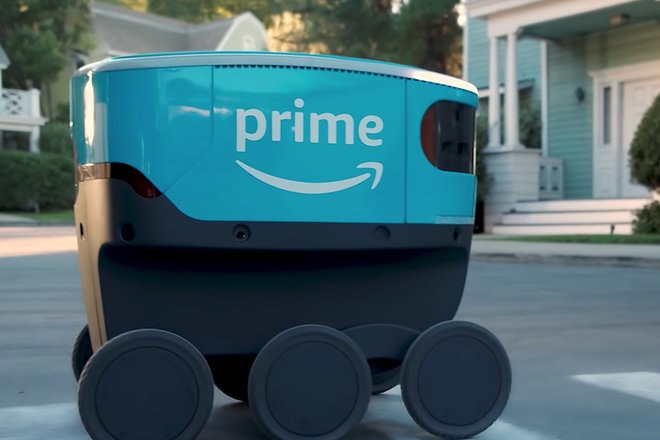
            I agree with the ideas this article brings to the table, for the most part. The one thing that I would like to see different is that last mile delivery robots be aerial systems and not ground. I understand the intention is to use this technology in less populated areas to reduce the amount of foot traffic the ground vehicles might see. However, this is the exact same reasoning I would use for developing unmanned aerial systems. It would be ideal to develop, practice and perfect UAS’s in less populated areas to demonstrate safe operations in highly populated areas. Another reason to use UAS’s in less populated areas is driving distance are increased because many of the houses are spaced out and ground vehicles would take much longer to reach these widely spaced apart homes; while a UAS could fly direct line of sight to and from each house, regardless of the highway infrastructure. I agree that shipping is a service that needs to become autonomous, in 2017 U.S. companies spent a record $1.5 trillion on shipping costs (Phillips, 2019).

            I disagree with the heightened security to prevent hackers from taking over these robots because the cargo they are carrying is mostly low price items and groceries. If something of high dollar value is being shipped, it would make more sense to pick it up from the manufacturer or shipping facility in person.

References

Hoffmann, T., & Prause, G. (2018). On the regulatory framework for last-mile delivery robots. Machines, 6(3) doi:10.3390/machines6030033

Phillips, E. (2019). Companies Spent a Record $1.5 Trillion on Shipping Costs in 2017. Retrieved from https://www.wsj.com/articles/companies-are-spending-more-on-shipping-and-thats-not-changing-soon-1529413500


New Military Strategy used to kill Enemy Submarines and Mines

The article I chose to cover the future of unmanned maritime systems (UMS) goes much further in depth than simply UMS’s. In addition to the Navy developing autonomous underwater vehicles (AUV’s) for Mine Countermeasures, they are developing technology that will be used to relay the sonar data from the AUV to the unmanned surface vehicle (USV) floating above. This USV will then be capable of transmitting the data through an air or space-based platform to relay information back to a shore-based command center. The concept of this linked AUV and USV remote detection system has earned the name of “Ghost Fleet” (Osborn, 2019). Currently AUVs and USVs are constrained to communicate between one another by a hardware or tether. Due to this limiting the distance the vehicles can travel from one another, a new technology is being developed to make them tether-less. These integrated systems would be an enormous tactical advantage because it would reduce the amount of time from learning an enemy’s position and being able to act accordingly. An additional technology being developed for the AUV’s is the ability to compile multiple AUV’s in one area and let them remotely map a minefield, or area of interest, while communicating with one another autonomously. This data can then either be relayed back to the USV and sent directly to warships in that area with real time mapping or the data can be stored on the AUV’s and collected at a later time. One more purpose for developing this technology is to use the autonomous feature of the AUV’s to act as a security perimeter in the waters surrounding the U.S. The AUV’s will be stealth like because they do not need additional systems like life support so they can operate with minimal noise output allowing them to go undetected. If a patrolling AUV locates an enemy submarine or enemy AUV, because we’re not the only country developing this technology, it will be able to follow it through the ocean while submerged which would result in a huge tactical advantage. Currently certain types of submarines have become extremely difficult to locate simply using sonar because as an encountering submarine approaches, both submarines turn off systems that make them detectable and essentially “go dark.”

https://i0.wp.com/u0v052dm9wl3gxo0y3lx0u44wz-wpengine.netdna-ssl.com/wp-content/uploads/2014/04/C-IMCMS-Containerised-Integrated-Mine-Countermeasures-System.jpg

            All of this technology is extremely critical in protecting the citizens of the United States. As I mentioned before, we are not the only country developing technology like this and we need to make sure our systems are superior to the enemy’s. I really like the idea of integrating underwater, surface and space systems to incorporate real time data transfer over what is currently used today. One of the more commonly known missile defense systems initiates by a satellite named Space Based Infrared Systems (SBIRS). This system is designed to detect U.S. bound, enemy, intercontinental ballistic missiles (ICBM) and autonomously launch countermeasures to ensure the enemy missile does not reach U.S. territory. I think system has progressed so much more quickly because it’s relatable to how UAV’s have more advanced technology that UMS. However, as technology advances there still needs to be a system in place that protects the U.S. from an underwater missile attack. The same systems being developed today will continue to evolve into more advanced systems and will quite possibly need to deter an underwater missile attack. In recent news there was speculation that Vladimir Putin and Russia have developed a massive nuclear weapon that if detonated near a shoreline could generate 300 foot tidal waves (Roger, 2018). However, if we continue to stay vigilant and continue furthering our unmanned maritime systems we will be able to detect and prevent things like this from happening. Hopefully if by the time it comes to something like that happening a majority of the maritime defense system could be fully autonomous or at least give us enough time to react with UMSs.

References

Osborn, K. (2019). The U.S. Navy Might Have Found a New Way to Kill Enemy Submarines. Retrieved from https://nationalinterest.org/blog/buzz/us-navy-might-have-found-new-way-kill-enemy-submarines-61117

Roger, J. (2018). Could an ‘insane’ Russian nuclear torpedo cause 300-foot tidal waves?. Retrieved from https://www.foxnews.com/tech/could-an-insane-russian-nuclear-torpedo-cause-300-foot-tidal-waves

Unmanned Systems – Definition

An unmanned system, to me, is a system that operates entirely on its own or with the assistance of a human operating the system remotely. Unmanned systems can range from a tiny drone up to the size of a rocket. They are also available in different applications such as underwater, on land, in the air and even space. We are already surrounded by thousands of unmanned systems that get us through the day and sometimes without even knowing they are present.