The journal article that I chose to review is titled “On the Regulatory Framework for Last-Mile Delivery Robots” and it digs into the many shortcomings of that technology. Important things like network security and customer satisfaction will drive the outcome of the project. The last mile delivery robots need to be able to securely deliver packages without being electronically hijacked by a hacker. The robots will also need to be able to deliver packages and at an efficient and timely manner and cannot spend too long looking for the drop off area and/or quickly recognize a gate or obstruction is blocking their ability to deliver the package. The robots need uphold high quality of service and not leave packages in the wrong place, damage shipping contents or lose packages all together.
The delivery systems will be comprised of two different parts, the reception box and the delivery box. The delivery box is what the robot will carry the package in as it makes its way to the reception box. The reception box will be installed into the customer’s garage or home yard. This should reduce the frequency of lost packages and help improve the customers trust and growth of the company. These robots are designed to operate under a new standard known as Industry 4.0. Industry 4.0 is being called nothing less than the fourth industrial revolution Hoffmann, T., & Prause, G. (2018). The idea is to use machine to machine (M2M) technology to reduce the amount of human hours required to complete a task, in this case its robot delivery. Due to these ground vehicles having to share their operating space with other stationary objects like homes and moving people, the desired area of operation will be in less populated areas. Since the robots will be operating in less populated areas, it more preferable to use ground vehicles over air vehicles as this reduces the complication by eliminating the need for three dimensional mapping and reducing it to only two dimensional.

In conclusion, there are two big ticket items that could potentially hold back these robots from being used by a shipping company. The first is the liability of the robot crashing or damaging itself and destroying others property of hurting people. This would be a huge risk for any size shipping company as it can lead to lawsuits and higher insurance premiums that might negated any profit savings. The second is how the public will react to robots roaming the same sidewalks as themselves and their families. A human delivery person can be much more friendly a personable than a robot because of their human capability. Robots might emit a negative aura because they cannot talk, smile and easily communicate with the public.
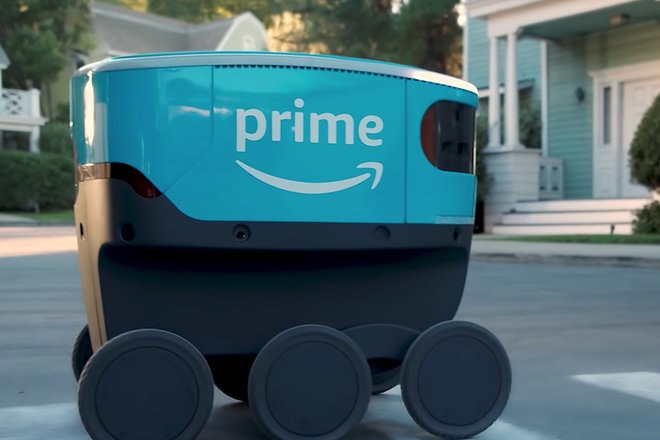
I agree with the ideas this article brings to the table, for the most part. The one thing that I would like to see different is that last mile delivery robots be aerial systems and not ground. I understand the intention is to use this technology in less populated areas to reduce the amount of foot traffic the ground vehicles might see. However, this is the exact same reasoning I would use for developing unmanned aerial systems. It would be ideal to develop, practice and perfect UAS’s in less populated areas to demonstrate safe operations in highly populated areas. Another reason to use UAS’s in less populated areas is driving distance are increased because many of the houses are spaced out and ground vehicles would take much longer to reach these widely spaced apart homes; while a UAS could fly direct line of sight to and from each house, regardless of the highway infrastructure. I agree that shipping is a service that needs to become autonomous, in 2017 U.S. companies spent a record $1.5 trillion on shipping costs (Phillips, 2019).
I disagree with the heightened security to prevent hackers from taking over these robots because the cargo they are carrying is mostly low price items and groceries. If something of high dollar value is being shipped, it would make more sense to pick it up from the manufacturer or shipping facility in person.
References
Hoffmann, T., & Prause, G. (2018). On the regulatory framework for last-mile delivery robots. Machines, 6(3) doi:10.3390/machines6030033
Phillips, E. (2019). Companies Spent a Record $1.5 Trillion on Shipping Costs in 2017. Retrieved from https://www.wsj.com/articles/companies-are-spending-more-on-shipping-and-thats-not-changing-soon-1529413500



 Application of Unmanned Systems